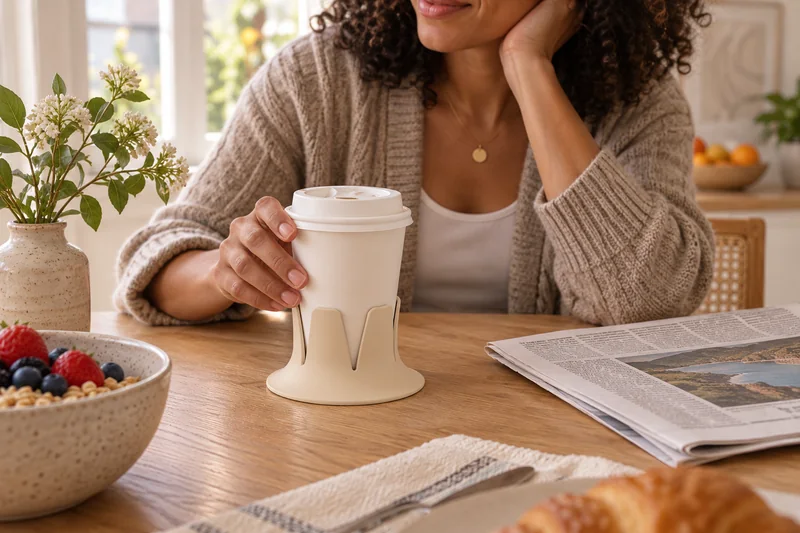
Why almost nothing holds a mug with a handle — and what actually does
A mug handle sits in the exact space every cup holder needs. Why that blocks most fixes, which options are left, and what actually works.
The short version, before you scroll: a mug handle sticks a few centimetres out from the side of the cup, at a height that changes from mug to mug, on a vessel whose base was deliberately designed to touch the table as little as possible. Nearly every product sold to hold a drink steady does its work at the base — a ring, a well, a clamp, a collar, a grip. The handle is standing in that space. It isn't a size problem you can solve by measuring more carefully. It's the same problem for almost every product in the category, which is why so few of them mention handles at all.
That's the bad news. The good news is that once you know which fixes the handle blocks and which it doesn't, the options get short, cheap and obvious.
The word tumbler is a small piece of evidence about how old this problem is. Etymologies vary, but two of the standing theories are that the glass originally had a pointed or convex base and simply could not be set down without spilling, and that these glasses had weighted bottoms that brought them back upright after a knock (Wikipedia)).
Look at what both theories have in common. One says never put it down. The other says build the answer into the vessel itself. Neither says "and then a second object holds it."
At sea they went further and built the answer into the furniture. Galley stoves are commonly gimballed so the liquid in the pans doesn't come out (Wikipedia)), and gyroscopes, ships' compasses, stoves and drink holders all use gimbals to stay level with the horizon while the boat rolls underneath them (Wikipedia). Philo of Byzantium (280–220 BC) described a gimballed inkpot. People have been serious about this for a long time.
Meanwhile, on land, the mug got a handle. And the handle has never, at any point in its history, been about keeping the mug upright.
A handle exists to keep your hand off the hot side of the cup, and its narrow cross-section limits how much heat travels up it. Mug walls are made thick for the same reason — to slow the drink cooling and to keep the outside tolerable (Wikipedia).
Then there's the detail that matters most here and that almost nobody thinks about: mug bottoms are frequently made concave or rimmed specifically to reduce thermal contact with whatever's underneath (Wikipedia).
Read that again with a spill in mind. Your ceramic mug isn't standing on a disc. It's standing on a thin ring of glazed clay around the outer edge, with a dish of air in the middle, and that gap is there on purpose — to protect the table from the heat. It is close to the exact opposite of what you'd draw if you wanted the cup to stay put. A glazed ceramic ring on a finished wooden desk is about as friendly an interface to sliding as you could arrange without trying.
So the standard mug is roughly 250–350 ml of hot liquid, sitting fairly tall, on a narrow low-friction ring, with a lever sticking off one side. It is a beautifully optimised object for hot and held. It was never optimised for set down and left, and it shows.
This isn't a theory. Wikipedia's own cup holder entry, describing the two hard problems for desk-type holders, lists the first as needing "a mechanism to hold the handle of the cup" — which it notes protrudes a few centimetres from the mug's side — and the second as the sheer variation in cup sizes (Wikipedia).
Two independent variables, both unruly. And the industry's whole vocabulary of solutions is circular. Factory cup holders in cars date back at least to the 1930s or 1940s, as shallow indentations moulded into the inside of the glovebox lid — the 1957 Chevrolet Bel Air had them — and in 1984 the Plymouth Voyager and Chrysler Town & Country became two of the first vehicles to offer cup holders as standard equipment (Wikipedia). Decades of development, and the shape has stayed a circle the whole time. Circles and handles do not get along.
A handle is also unruly in more ways than its width. It varies in how far out it reaches, how thick it is, how high on the wall it starts, how far down it comes, and whether it's a loop, a D, a half-moon or a stub. To hold a handled mug, a ring would need a notch — and a notch has to be aimed. You'd have to rotate the mug to one specific orientation every time you set it down, half-asleep, one-handed, holding a phone. That's why you rarely see it, and why the ones that exist tend to be so oversized that they no longer hold anything snugly.
This is the taxonomy worth carrying around, because it tells you instantly whether any given product is even a candidate.
1. The enclosing ring or well. Car cupholders, clamp-on desk holders, camp-chair sleeves, gimballed marine holders. All of them are a circle that the cup passes down into. The handle has to clear the rim on the way in and has to sit somewhere once it's there. Handle: blocked, unless the ring is wide enough to be no longer gripping the cup.
2. The base-gripping collar. A flexible sleeve, boot or set of fins that closes on the bottom inch of the container and widens what it's standing on. Physically the strongest of the passive options, because it changes the geometry of the footprint rather than just the friction. It also needs that bottom inch clear the whole way round — and on a huge number of mugs the handle sweeps down into exactly that band. Handle: blocked. This is the family our own product belongs to, and it is an honest no for handled mugs. More on that below, because the honest answer is the useful one.
3. Grip built into the vessel's own base. The no-tip mug approach: the drink and the holding mechanism ship as one object. The maker's own description of the best-known version is that it grips the table when you knock into it and releases when you lift it straight up (The Mighty Mug). Because the mechanism lives underneath the cup, a handle doesn't interfere with it at all. Handle: not blocked — but you're buying their vessel, not keeping yours, and any grip that acts between a base and a table is only as good as the table. A grip that works by squeezing air out from under a base needs a flat, non-porous surface to hold, because porosity and unevenness let air leak back in and the hold decays (Wikipedia, suction cup). Whether that class actually holds on a car console or a camp table is a separate question, and we've written it up separately.
4. Friction under the base. A tacky mat, a grippy pad, a rubber coaster. It doesn't care what shape the cup is, doesn't care about the handle, doesn't care about the lid. Handle: not blocked. It's the weakest intervention on this list and the only universal one.
And then there's the fifth thing, the one nobody counts as a holder:
5. The hook. Mug trees and racks hold mugs by the handle — hooks and arms are the standard form (Wikipedia). It's the only family of solution where the handle isn't a liability but the entire mechanism.
Half the frustration in this category comes from buying a fix for one problem to solve a different one. There are three, and they behave differently.
Sliding. The cup stays upright but travels — down a rain-sloped porch rail, across a console under braking, along a camp table that's settled crooked. Friction fixes this. A pad or a mat genuinely solves it, and it's cheap.
Tipping. The cup goes over. Friction barely helps here; something that resists tipping has to change what the cup is standing on. Engineers describe the general principle plainly enough — you keep the mass over the space bounded by the supports (Wikipedia, centre of mass). Widen that space and it takes a bigger tilt to leave it. This is the family the handle blocks.
Consequence. The cup is fine; the laptop isn't. Nothing under the mug helps with this one. Only distance and lids do.
Most people shopping for "something to hold my coffee" have a consequence problem and are buying a tipping product to solve it. Sort out which of the three you actually have and the shopping list rewrites itself.
Ranked roughly by how much they cost you, which is not the same as how well they work.
Turn the handle away from traffic. Free, takes half a second, and almost nobody does it. On a nightstand or a crowded desk, the handle is the part your hand finds first — a lever sticking out into the swept path of a blind reach for a phone or a lamp. Point it at the wall and away from the keyboard. It stops being a snag.
Move the mug, not the furniture. The desk problem is usually a consequence problem, and consequence is solved by geometry. Far side of the keyboard rather than the near side. Behind the monitor riser. On a second small shelf. It costs nothing and it's the single highest-value move available to anyone drinking out of a handled ceramic mug at a desk. Verdict: fixes consequence entirely, fixes nothing else.
A non-slip mat or grippy coaster. The tacky matting sold by the roll as shelf liner does the same job as anything sold specifically for drinks. Works with any mug, handle or not, because it lives under the base. Verdict: genuinely fixes sliding on slopes and in moving vehicles. Does not stop a knock from tipping the mug, and a paper coaster does nothing at all.
Put a lid on it. The other axis entirely: if you can't stop the tip, contain the contents. A handled travel mug with a real lid means a knock costs you a startle instead of a keyboard. Verdict: the only option here that limits damage after the fall, which is why it's underrated.
Hang it, at least outdoors. At a campsite there is often no flat surface worth arguing with, and the handle finally earns its keep — a carabiner on a pack strap, a hook on a tent pole, the loop handle on a piece of enamelware. Classic camp mugs are built on a heavy-gauge steel base under a speckled enamel finish, which GSI says is what keeps them looking good for years (GSI Outdoors). Verdict: free, and the only fix that's better outdoors than indoors.
Give it a dedicated home with walls. A caddy, a drawer-style holder, a deep tray on the nightstand. It has to be open on one side for the handle, which weakens it, but a walled home means a nudge is caught by something. Verdict: works if you'll actually put the mug back in it every time. Be honest with yourself about that. And note that a charging dock is not a wall — the Ember Mug 2 ships with a charging coaster, but that coaster is a power connection, not a restraint (Ember).
Keep a second, handle-less vessel for the surfaces that move. This is the option most people arrive at eventually, and the market has already voted. Fellow's Carter Wide Mug is a straightforward attempt to give you the ceramic-mug drinking experience with no handle at all, at an 85 mm body (Fellow); car-oriented travel mugs are routinely built with a deliberately narrow base to seat in a factory holder. The handled mug stays on the desk where you control the geometry. The keep cup, tumbler or to-go cup handles the car and the campsite — and because those are handle-less, every option in this article is open to them, including the bottom-gripping collars. Verdict: the most effective fix, at the cost of owning two things.
If the shake is in your hand, not the table, that's a different aisle. Rotating-handle cups exist for exactly this — HandSteady builds a cup around a handle that turns, aimed at people whose grip or steadiness makes an ordinary fixed handle awkward (HandSteady). Two-handled cups and weighted bases belong to the same world. Different problem, real solutions, worth knowing about if that's the actual issue.
We make a bottom-gripping collar, which puts us squarely in category 2 above. So, plainly, before anything else:
A mug with a handle is a no. Not because the base is the wrong size — because the fins have to close around the bottom inch of the container, all the way round, and on a handled mug that's where the handle comes down. There's no version of this where you measure your mug carefully and it turns out fine. If your one cup is a handled ceramic mug and it always will be, the useful things on this page for you are further up: turn the handle away, move the mug, put a mat under it, or hang it outdoors.
What it does do, for handle-less containers: it's a single piece of Shore 85A TPU — never silicone — with a fixed base 5.2 inches across that does not expand, contract or deform, standing 2.8 inches tall. The fins flex to grip the bottom inch of the container. Because that base is fixed and wide, it widens the base of support: the container's centre of mass has to travel further horizontally before it passes outside that base, so tipping takes a much larger tilt. The tack of the TPU resists sliding. It settles in and holds steady with the handle-less containers coffee actually comes in — travel tumblers, to-go paper cups, cold brew jars, camp cups.
The rest of the honest limits, in one breath: it does not float, it sinks. It is not a mount, a clamp, a strap or a restraint. It does not insulate and it does not seal. A direct hard knock still wins. It's dishwasher safe, it's molded in Orange, California, and it's patent pending. If you want to check whether the container currently in your hand actually seats in it, the fit guidance lives at steadilabs.com, and there are 90 days from delivery to decide, with free returns — used is fine.
Purchases go through steadilabs.com — the maker, directly.